
How to Feel More Confident in an Interview
Updated: 1 day ago
To feel more confident in an interview, prepare evidence you can explain, practice speaking it aloud, and make the first few minutes familiar. You do not need to eliminate every nerve. You need a reliable way to begin, answer the question, and recover when the conversation surprises you.
Confidence is easier to build around specific preparation than around telling yourself to be confident. The seven steps below give you something practical to do before the interview and a few ways to regain your place during it.
1. Identify what the employer needs
Read the job description and choose three important responsibilities. For each, write one sentence explaining how your experience relates to it. That turns a vague fear of being judged into a smaller task: show that you can do the work.
If you do not have the exact experience, identify an adjacent skill and the gap you would need to close. You can say that honestly. Pretending to know more than you do makes follow-up questions harder.
2. Build a small bank of real examples
Prepare examples of a result, a difficult decision, collaboration, and something you learned. Note the situation, your responsibility, the action you took, and the outcome. Keep the notes short enough to use as reminders rather than a script.
When I interview candidates, I find specific actions easier to assess than confident adjectives. “I clarified the buyer’s approval process and changed the proposal” tells me more than “I’m a great communicator.” Use the facts that are true for you.
3. Rehearse the first minute
Practice a short introduction that connects your current experience to this role. Say it aloud two or three times using different wording. Aim for a clear starting point and a reason the role interests you. Avoid memorizing every word.
Hypothetical opening: “I work in account management, where I handle renewals and coordinate customer issues with our service team. I’m interested in this role because it adds more responsibility for developing new business. The experience I’d bring is understanding customer needs and keeping commitments organized.” Adapt the content to your own background.
4. Practice follow-up questions
Ask someone to interrupt a prepared answer with “Why did you choose that?”, “What did you personally do?”, or “What would you change?” If practicing alone, record the answer, then respond to one follow-up without restarting.
Review whether your point is clear and supported. You do not need to remove every pause or filler word. Focus on one useful change at a time, such as answering the question earlier or shortening the background.
5. Make interview-day logistics predictable
Confirm the time, format, contact, location, and any preparation instructions. For a video call, check audio, camera, connection, and a backup contact method. For an in-person interview, plan the route and arrival time. Set out what you need the evening before. For format-specific checklists, see the virtual interview tips and the on-site interview preparation guide.
Keep one page of notes with the role’s priorities, your example prompts, and questions for the interviewer. Follow the employer’s rules about notes or assessments. A preparation routine helps you arrive with fewer avoidable distractions.
6. Give yourself a recovery sentence
If you lose your place, pause and use a straightforward sentence. “Let me give you the main point first” helps you restart a long answer. “Could you clarify which part you’d like me to focus on?” helps with an ambiguous question. A brief pause is often less disruptive than filling the space with an invented answer.
If you cannot answer a technical question, state what you know and where your uncertainty begins. Explain how you would find the missing information if the question allows it. Confidence includes being accurate about your limits.
7. Treat the interview as a two-way conversation
Prepare questions that help you understand expectations, support, and the work itself. Ask what successful performance looks like, which challenge needs attention, or how the team makes decisions. Listen to the answers rather than planning your next speech.
Afterward, write down one thing that went well and one adjustment for next time. An interview outcome also depends on the employer’s needs and other candidates. Use what you can learn without treating every rejection as a judgment of your overall ability.
A short rehearsal you can use tonight
Take ten minutes to say your introduction, explain one example, answer a follow-up, and ask one employer question. Repeat only the part that needs work. Finish by checking the interview details and putting your notes aside.
Use the seven-step interview preparation guide for the wider plan and the guide to tough questions without sounding rehearsed for unexpected follow-ups. The course below gives you a structured way to choose and explain examples.
Ready to walk into your next interview with confidence?
The Confident Interview Method gives you a focused, one-hour way to choose stronger examples, answer difficult questions, and speak clearly without memorizing a script. Start here if you want a complete preparation process you can reuse before future interviews.

The Confident Interview Method
$29
One focused hour with 10 practical lessons you can use in your very next interview.
“After spending hours reading blogs and articles, I am so glad that I bought this. It covered what I think are the most important parts of interviewing. Thanks for making this so concise.” - Drew Whitehead
Prefer a faster, lower-cost option?
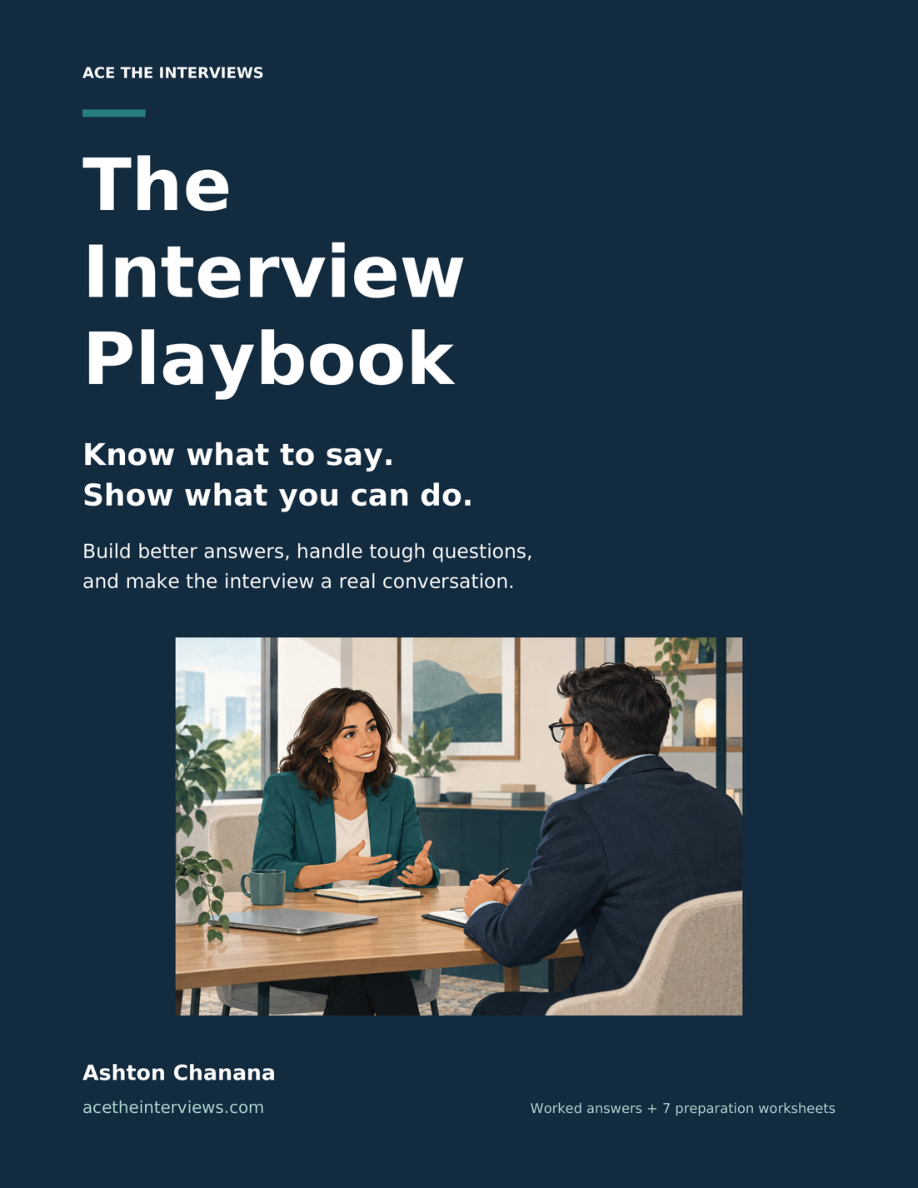
The Interview Playbook eBook gives you practical strategies for preparation, communication, body language, and interview practice that you can start using right away.
Frequently asked questions
How can I look confident when I still feel nervous?
Speak at a pace you can maintain, answer the question directly, and use real examples. You can feel nervous and still communicate clearly. Avoid forcing a performance that makes it harder to listen.
Should I memorize my interview answers?
Memorize the key facts and structure rather than every sentence. Practice different wording so you can adapt when the interviewer asks the question another way.
What if I have little interview experience?
Start with a small rehearsal and one realistic mock conversation. Use relevant examples from work, study, volunteering, or projects, and be honest about what you have not done.
What should I do if I freeze during an answer?
Pause, ask for a moment, and restart with the main point. If the question is unclear, ask a focused clarification. You can correct yourself without apologizing through the rest of the answer.



Comments