
Executive Presence in Interviews: How to Speak With Confidence

Updated: Oct 10
You do not need to feel completely calm to give a credible interview answer. You need to help the interviewer follow your thinking, understand your contribution, and see how you respond when the conversation becomes difficult.
That is a useful way to approach executive presence in an interview: make your judgment easy to understand. A polished introduction helps, but your presence is also shaped by the examples you choose, the questions you ask, and how honestly you handle uncertainty.

What executive presence looks like in an interview
The phrase can sound vague. Turn it into behaviors you can practice:
Clarity: answer the question before adding background.
Credibility: distinguish your own decisions from the team's work.
Composure: take a moment, clarify the question, and recover when you lose your place.
Judgment: explain what you considered and why you chose a particular approach.
Connection: listen carefully and respond to the person in front of you.
I find it more useful to prepare for those behaviors than to chase a particular leadership image. In sales and leadership conversations, a clear explanation of a tradeoff gives me more to assess than a confident claim with no evidence behind it.
Prepare three examples that show your judgment
Choose a decision you made, a difficult conversation you handled, and a situation where the first plan did not work. Each example should connect to the role you are applying for.
For each one, write five short notes: the goal, the constraint, your decision, the reason for it, and the result. Include a real measure if you have one. If the result was mixed, explain what improved and what still needed work.
For example, a sales leadership candidate might discuss balancing the pressure to close a deal with a customer's implementation needs. A marketing candidate might explain why they stopped a campaign that attracted attention but produced few qualified inquiries. These are hypothetical topics, not outcomes to borrow.
Prepare the details that a follow-up question could test. Who disagreed? What information was missing? What would you change? If you only rehearse the successful ending, you may struggle when the interviewer asks about the decision itself.
Start with the point, then support it
A nervous answer often begins with every piece of background. Try a simple opening that tells the interviewer where you are going.
“The most important change I made was to clarify ownership before we added more activity. Two teams were working on the same accounts, so I agreed a handoff process with the other manager and tested it with a small group first.”
This hypothetical opening makes the decision clear. The candidate can then explain the context, what the test showed, and the result. It does not need a dramatic introduction.
Use a pause between the main point and the supporting detail. Speak at a pace that lets you finish the thought comfortably. There is no need to lower your natural pitch, remove every filler word, or sound like someone else.
If you tend to ramble, practice ending after the result and lesson. You can add, “I can go into the implementation if that would be useful.” That gives the interviewer a choice about the level of detail.
Show how you handle a challenge
An interviewer may question an assumption or ask why you did not choose another option. Treat that as a chance to explain your thinking.
When someone challenges your decision
“That was the main alternative we considered. I chose the smaller test because we did not yet know whether the handoff was causing the delay. A wider rollout would have been reasonable if we already had that evidence.”
The example acknowledges the alternative and explains the condition behind the choice. Adapt the structure to a decision you actually made.
When you do not know the answer
“I have not worked with that system directly. I would first check how the team uses it and which reporting decisions depend on it. My closest experience is with a different platform, where I was responsible for validating the pipeline data.”
Be specific about the gap and the relevant experience you do have. Avoid presenting a confident guess as a fact.
When you lose your place
“Let me bring that back to your question. The decision I owned was the handoff process, and the outcome was…”
A short reset is enough. You can also ask for a moment to think. Repeated apologies may take attention away from the substance of your answer.
Use comfortable, attentive body language
Choose a position that lets you sit or stand comfortably and speak without strain. Keep your notes easy to consult. If you use gestures naturally, allow them to support the point rather than monitoring every movement.
Eye contact, movement, facial expression, and speaking style vary between people and cultures. Do not treat one posture or amount of eye contact as a reliable measure of competence. Focus on being engaged in a way that is comfortable and workable for you.
For a video interview, check the camera position, sound, lighting, and connection before the meeting. Put any reference notes near the screen so you can use them briefly without losing track of the conversation. The goal is an easy conversation, not a performance for the camera.
Our interview body language guide covers practical preparation in more detail.
Ask questions that reveal priorities
Your questions can show how you think about the work. Ask about a real responsibility in the job description and listen to the answer before moving to the next question.
“What would you most want the person in this role to improve in the first few months?”
“Which decisions would I own, and which would need agreement across teams?”
“What tends to make someone struggle in this role?”
Follow up on something specific: “You mentioned inconsistent forecasts. Is the main issue data quality, deal qualification, or the review process?” Use the team's answer, rather than assuming you have diagnosed the problem.
When I prepare for a leadership conversation, I try to connect each question to a decision the role will need to make. That keeps the discussion grounded in the work instead of in broad promises about influence or confidence.
A ten-minute executive presence practice
Choose one question. Use a decision or challenge relevant to the role.
Write a one-sentence opening. State the main action or lesson.
Record one answer. Use your five example notes, then stop after the result.
Review for clarity. Could someone identify your decision, your reason, and your contribution?
Practice a follow-up. Ask yourself why another option was not chosen.
Repeat once. Change the unclear part rather than memorizing the whole answer.
If nerves are getting in the way, start with a shorter practice conversation. Our guide to preparing when you feel interview anxiety offers additional ways to organize your preparation.
Ready to walk into your next interview with confidence?
The Confident Interview Method gives you a focused, one-hour way to choose stronger examples, answer difficult questions, and speak clearly without memorizing a script. Start here if you want a complete preparation process you can reuse before future interviews.

The Confident Interview Method
$29
One focused hour with 10 practical lessons you can use in your very next interview.
“After spending hours reading blogs and articles, I am so glad that I bought this. It covered what I think are the most important parts of interviewing. Thanks for making this so concise.” - Drew Whitehead
Prefer a faster, lower-cost option?
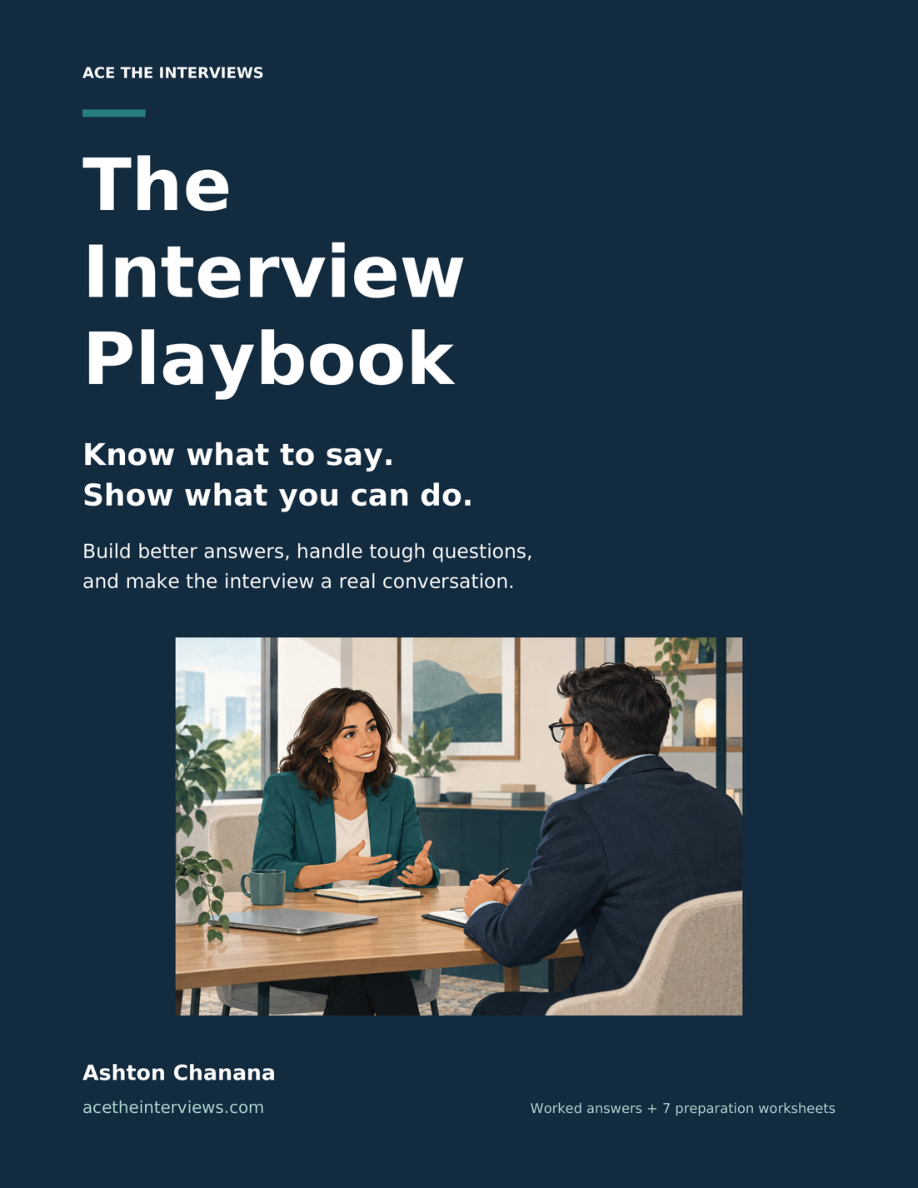
The Interview Playbook eBook gives you practical strategies for preparation, communication, body language, and interview practice that you can start using right away.
Frequently asked questions
Do I need executive presence for a non-management interview?
You can use the same habits at any level: answer clearly, explain your contribution, listen, and handle uncertainty honestly. Choose examples that fit your responsibilities rather than trying to sound like a senior executive.
Can an introvert show executive presence?
Yes. You can communicate with a quieter style and still make your thinking clear. Prepare useful examples and questions, and give yourself room to pause before answering.
Should I hide that I am nervous?
You do not need to discuss every nervous feeling or try to eliminate every visible sign. Focus on answering the question and use a brief pause or reset when you need one.
How can I sound more confident without exaggerating?
Use specific language about what you did and why. Replace “I am an excellent leader” with an example of a decision, conversation, or improvement you owned. Be clear about both the result and its limits.



Comments