
The Perfect Pitch: How to Answer “Tell Me About Yourself”
Updated: Oct 3
“Tell me about yourself” is usually an invitation to explain why your background makes sense for this job. You do not need to tell your life story or squeeze your entire resume into a minute. Give the interviewer a useful starting point, then let the conversation develop.
A good answer covers where you are now, the experience that prepared you, and why this role is a sensible next step. You can usually do that in about 45 to 90 seconds. If the interviewer asks for more detail, you have plenty of room to go deeper.

The simple present, past, future structure
Start with your current work or the most relevant part of your background. Pick one accomplishment or responsibility that relates to the job. Then connect that experience to the opportunity in front of you.
Present: “I’m currently a customer success manager working with midmarket software clients. I focus on onboarding and retention.”
Past: “Before that, I supported implementation projects, where I learned how to turn technical problems into clear next steps for customers.”
Future: “This role interests me because your team is building a more hands-on customer experience, and I’d like to bring both sides of that experience to it.”
That is a framework, not a script to copy. Replace every detail with your own work. If you are a student, between jobs, or changing fields, begin with the most relevant project or experience instead of apologizing for your current title.
A full example you can adapt
Suppose a marketing candidate is interviewing for a role that combines content and campaign measurement. A grounded answer might sound like this:
“I’ve spent the last three years building email and content campaigns for a small consumer brand. Most recently, I worked with our sales and support teams to understand the questions new customers kept asking, then updated our welcome emails around those questions. Earlier, I managed our blog and learned how to use search and customer feedback to choose topics. I’m interested in this role because it brings those two parts together: making useful content and checking whether it actually helps people take the next step.”
The example does not claim a dramatic percentage gain without evidence. It makes the person’s role, decisions, and fit clear. If you have a real result, include it with enough context to explain what changed and how you measured it.
When I interview candidates, I would rather hear a clear decision they made than a polished biography. The answer gets stronger when I can ask a follow-up and the person can explain the work in their own words.
How to tailor it to the job
Read the posting and choose two or three priorities that show up repeatedly. If the job emphasizes client relationships, start with a relevant client situation. If it emphasizes analysis, choose a decision you made using evidence. You do not have to repeat the posting’s keywords verbatim.
For a sales role, you could say: “I work with business owners who need to understand a complex service before they can make a decision. I’ve learned to ask better questions early, explain the tradeoffs plainly, and follow through after the sale. I’m interested in this role because it calls for that same consultative approach.” Add a real result or example only if it is yours.
For a technical role: “I’m a software engineer focused on improving the systems people rely on every day. In my last project, I helped identify a slow part of the application, tested the likely causes, and worked with the team on a fix. I’m drawn to this role because I’d get to solve that kind of practical performance problem at a larger scale.” Be ready to explain exactly what you did if asked.
For an early-career candidate: “I recently completed a data analysis program and used my final project to study where customers dropped out of a sign-up process. I cleaned the data, built a simple report, and presented two changes the team could test. I’m looking for a role where I can keep improving those skills while working with people who use the findings.” A class, volunteer, or personal project can be useful if you describe its scope honestly.
What to leave out
Do not start at the beginning of your resume and recite every job. The interviewer has your resume. Choose the experiences that explain this application.
Avoid “I’m a hardworking team player” unless you can immediately show what that looked like. One specific decision is more memorable than a stack of adjectives.
Do not invent a result or borrow the example numbers you see in interview articles. If a result is confidential or unavailable, describe the goal, your contribution, the evidence you used, and what you learned.
Personal details are optional. A brief interest can help when it genuinely connects to your work or the interviewer invites it, but the core answer should make your professional fit easy to understand.
Practice the shape, not every word
Write three short notes: what you do now, one relevant experience, and why this job. Say the answer out loud and time it once or twice. If it runs long, cut background that does not help the interviewer understand your fit. Then practice a shorter version for a quick introduction and a longer version for a conversational interviewer.
End after you have connected your experience to the role. You do not need a formal closing line like “That’s a little about me.” A natural ending gives the interviewer an opening to ask about the project you mentioned. If they interrupt with a question, follow the conversation instead of trying to finish a memorized speech.
For more on staying flexible when the questions get harder, see How to Answer Tough Interview Questions Without Sounding Rehearsed.
An elevator pitch for a networking event is related, but it has a different audience. You might lead with your name and what you are looking for when meeting someone new. In an interview, the employer already knows your name and has a specific role in mind, so focus on that fit.
Ready to walk into your next interview with confidence?
The Confident Interview Method gives you a focused, one-hour way to choose stronger examples, answer difficult questions, and speak clearly without memorizing a script. Start here if you want a complete preparation process you can reuse before future interviews.
The Confident Interview Method
$29 · One focused hour with 10 practical lessons you can use in your very next interview.
“After spending hours reading blogs and articles, I am so glad that I bought this. It covered what I think are the most important parts of interviewing. Thanks for making this so concise.” (Drew Whitehead)
Prefer a faster, lower-cost option?
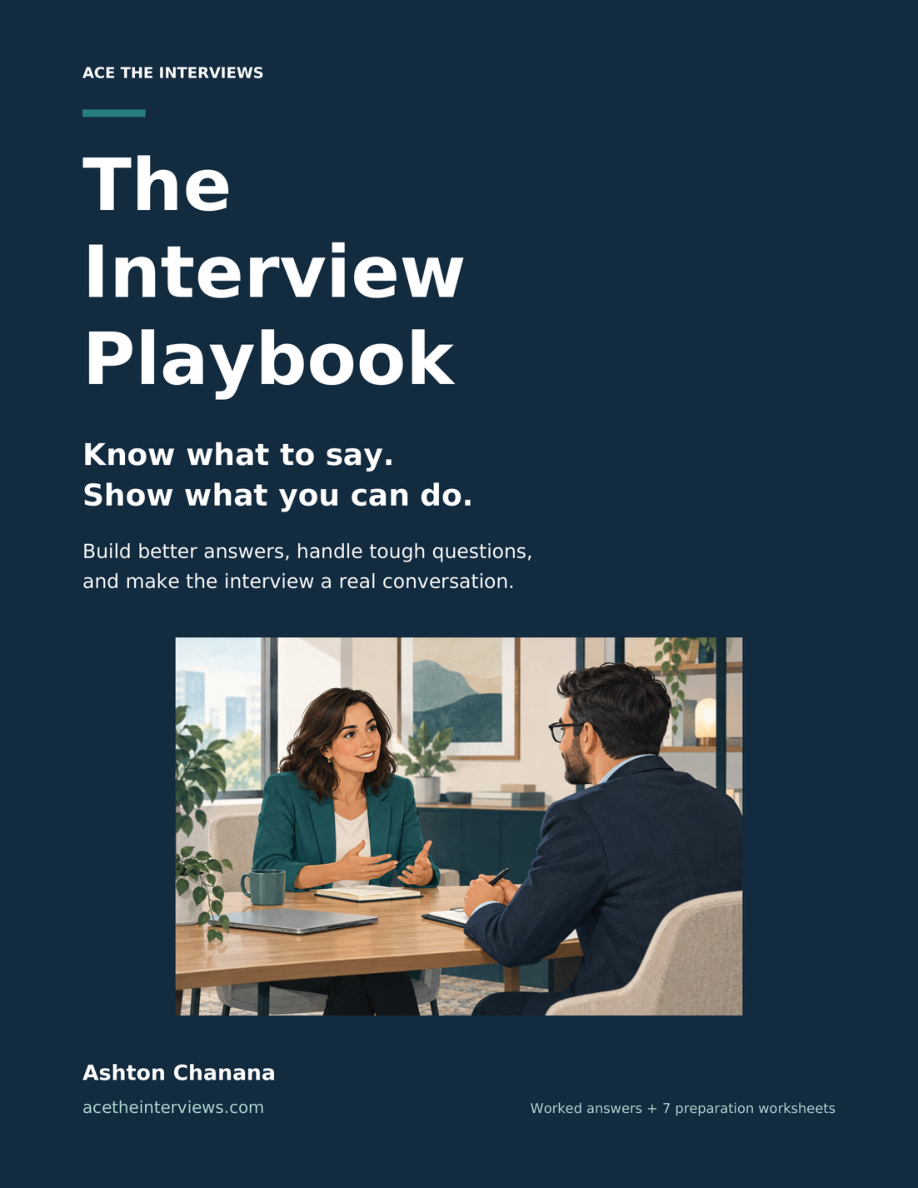
The Interview Playbook eBook gives you practical strategies for preparation, communication, body language, and interview practice that you can start using right away.
Frequently asked questions
How long should “Tell me about yourself” be?
About 45 to 90 seconds is a useful starting range. A senior candidate with a more complex background may need a little longer. Watch whether the interviewer wants a summary or a deeper story, and leave room for follow-up questions.
What if I am changing careers?
Lead with the work that carries over. Explain one transferable skill with a concrete project, then connect it to the new role. You do not need to pretend the two fields are identical.
Should I mention a career gap?
You can briefly place it in context if it helps the timeline make sense, then return to what you bring to the role now. The opening answer does not need to cover every detail of your employment history.
Can I use the same answer for every interview?
Keep the same core experiences, but change the emphasis. The best example for a client-facing role may be different from the best example for an analytical role. Your facts stay true; the connection to the job becomes more specific.



Comments