
How to Prepare for a Marketing Job Interview: A Practical Guide
Updated: Oct 18
A marketing interview gives you a chance to show how you make decisions, not just name the channels you have used. The strongest preparation is to choose a few real projects and explain the audience, the goal, the work you owned, what you measured, and what you would change next time.
You do not need to arrive with a full campaign proposal for a company you have never worked at. A little focused research and honest examples will give you better material than a list of buzzwords.

Start with the role and the audience
Read the job description and mark the responsibilities that come up more than once. A content role may emphasize search, editorial planning, and distribution. A product marketing role may emphasize positioning, launches, and sales enablement. A performance role may care more about testing, budgets, and conversion quality. Choose examples that fit the work this team is hiring someone to do.
Then look at the company's website, a recent campaign or two, and its public customer language. Ask yourself: Who appears to be the audience? What problem is the company helping them solve? Which promise does it make, and where does the visitor go next? Write down one or two observations and a question. You are learning the context, not diagnosing the entire business from the outside.
For example, you might say, “I noticed that the product pages emphasize ease of setup, while the customer stories focus on saving time after launch. How does your team decide which benefit to lead with for a new audience?” That question shows attention to the message and invites the interviewer to explain the strategy.
Choose two or three portfolio stories
Pick work that illustrates different parts of the role. You might bring one audience or positioning decision, one channel execution, and one project where you learned from a result that surprised you. A portfolio link helps, but you should also be able to tell the story without opening a slide deck.
For each example, prepare five notes: the goal, the audience, your responsibility, the choice you made, and the evidence you used to judge it. Explain your contribution if a team owned the project. If a number is confidential or you did not have access to the final result, say so and describe what you could observe.
Here is a model answer for a digital campaign. Treat it as a structure to adapt, not a result to claim: “Our team wanted more qualified demo requests from small businesses. I reviewed the questions prospects asked sales, then wrote a short email sequence around the two objections that kept recurring. I worked with design on the landing page and checked both click-throughs and completed demo requests after launch. One message drew attention but fewer qualified requests, so we revised its promise. I learned to evaluate the quality of the next step, not just the volume of clicks.”
Notice the sequence: audience evidence, a specific action, a measure tied to the goal, and a change. Your own story will be more persuasive when you can explain why you chose that channel and what alternatives you considered.
Refresh the fundamentals you will actually use
Be ready to discuss segmentation, positioning, the customer journey, channel selection, and measurement in plain language. For a digital role, revisit the tools and methods named in the posting. If you have used an analytics platform, explain a decision it helped you make. If you have not used the exact tool, describe the comparable work you have done and what you would need to learn.
Metrics need context. Reach or impressions can show exposure, while clicks may show initial interest. Conversion rate depends on what counts as a conversion and who entered the funnel. Cost per acquisition needs a defined spend and acquisition event. Match the measure to the campaign goal and acknowledge what it cannot tell you on its own. A high click rate does not prove that the right people became customers.
If the interviewer asks about a trend or a new tool, connect it to a practical test. You can say which audience problem it might address, what small experiment you would run, and how you would decide whether to keep using it. There is no need to claim expertise in every platform.
Practice likely marketing interview questions
“Tell me about a campaign that did not go as planned.” Choose a real example and describe the first signal that something was wrong, your diagnosis, the change you made, and what happened. A modest, well-explained recovery is useful evidence of judgment.
“How do you decide which channel to use?” Start with the audience and objective, then explain the constraints. Where does the audience already look for information? Is the goal awareness, a qualified lead, or retention? What resources can the team sustain? A channel is a means to the goal, not the strategy itself.
“How do you measure success?” Name the primary outcome and one or two supporting signals. State the time window and the limits of attribution if those mattered. If your team measured only engagement, do not turn that into a revenue claim.
“How would you market our product?” Ask clarifying questions before offering a plan. You can outline an initial audience hypothesis, message, channel test, and measure, while explaining what you would need to learn from customers and internal data. The interviewer is usually listening for your reasoning.
For more examples, read Common Marketing Interview Questions and How to Answer Them. That guide covers a broader question bank; use this page as your preparation checklist.
Show how you work with other people
Marketing rarely happens alone. Prepare one example of working with sales, product, design, or customer support. Explain how you handled a disagreement about the audience, message, timing, or measure. “I collaborated with sales” is a starting point. “I asked sales which objections stalled demos, then changed the email sequence and checked the quality of requests” shows what you did together.
Use a simple situation, action, result structure for behavioral questions. Spend most of the answer on your decision and its effect. If the result was mixed, say what you would change. Honest reflection is more useful than a polished story that leaves the interviewer unable to tell what you owned.
Ask questions that help you evaluate the role
You can ask: “Which audience and business outcome matter most to this role in the first six months?” “How do marketing and sales decide whether a lead is useful?” “What campaign taught the team something surprising?” “Where does this person have room to test an idea?” Choose the ones that fit the conversation rather than reading a long list.
Before the interview, put the role priorities, two or three project notes, your questions, and any portfolio links on one page. Practice explaining each project out loud. If you can describe the choices without reciting a script, you are ready to have a useful conversation.
Match your practice to the marketing specialty
If you are early in your career, start with the marketing internship questions or marketing assistant examples. A class or volunteer project can work well if you explain its audience, your contribution, and one change you made after feedback. For an internship exit conversation, use the internship exit interview guide to reflect on what you learned and ask for useful feedback.
For specialist roles, use the content marketing manager questions, product marketing manager questions, or branding interview guide. Bring an example of the choice you made, not just the asset you produced. A content story might explain why a topic mattered to buyers; a product marketing story might explain why one benefit became the lead message.
If you coordinate campaigns across teams, work through the marketing project manager questions. Explain how you handled a dependency, a late change, or a disagreement over priorities. For executive roles, the VP of marketing guide asks you to connect those decisions to budgets, team capacity, and business outcomes.
Ready to walk into your next interview with confidence?
The Confident Interview Method gives you a focused, one-hour way to choose stronger examples, answer difficult questions, and speak clearly without memorizing a script. Start here if you want a complete preparation process you can reuse before future interviews.
The Confident Interview Method
$29 · One focused hour with 10 practical lessons you can use in your very next interview.
“After spending hours reading blogs and articles, I am so glad that I bought this. It covered what I think are the most important parts of interviewing. Thanks for making this so concise.” (Drew Whitehead)
Prefer a faster, lower-cost option?
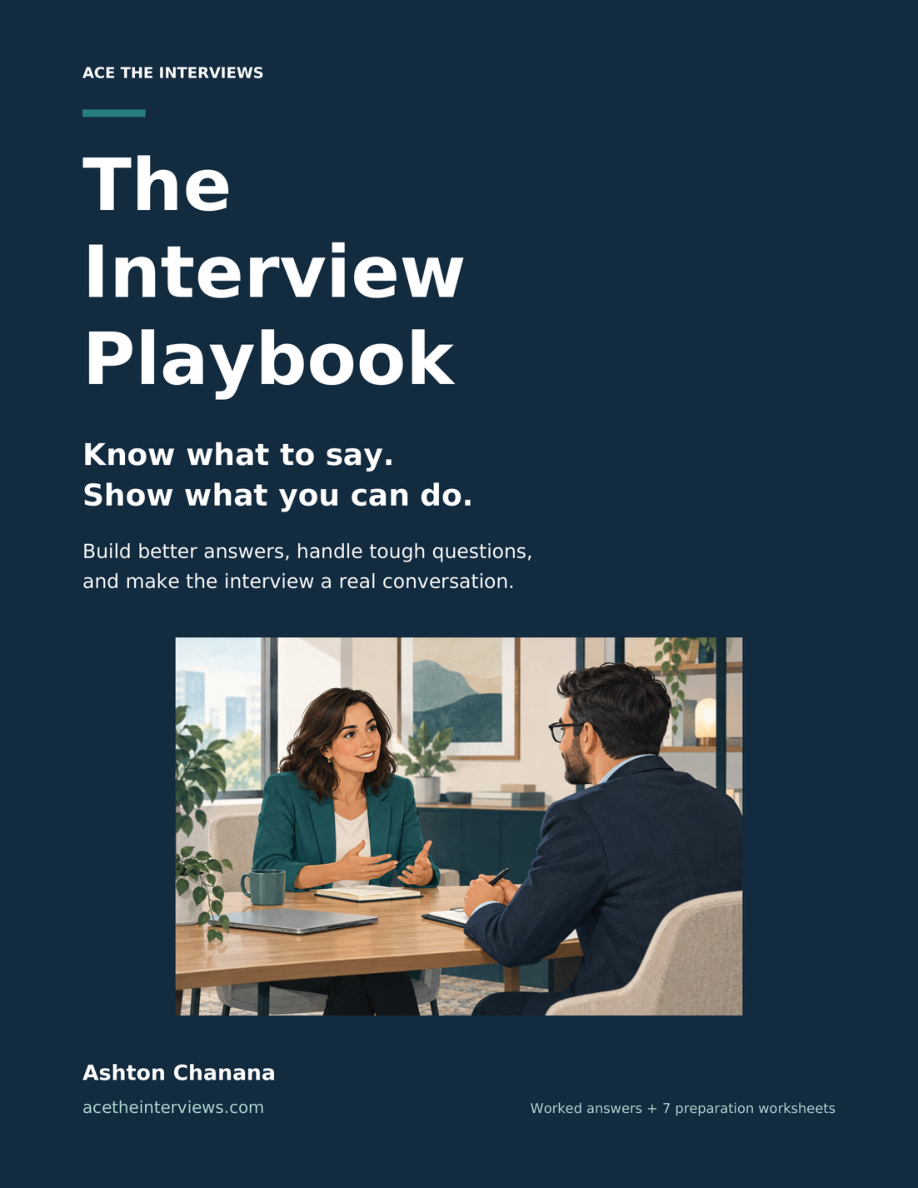
The Interview Playbook eBook gives you practical strategies for preparation, communication, body language, and interview practice that you can start using right away.
Frequently asked questions
Should I bring a marketing portfolio?
Bring a short selection if you have permission to show the work. Label your contribution and any confidential limits. If the work cannot be shared, describe the problem, decisions, and results in words.
What if I am new to marketing?
Use a class, volunteer, internship, or personal project with a real goal and audience. Be precise about its scope. Explain what you tried and what you learned, without presenting a practice project as a paid campaign.
Should I critique the company's marketing in the interview?
Frame an observation as a question or hypothesis. You do not have the team's customer research, budget, or performance data. Thoughtful curiosity usually opens a better discussion than a confident verdict based on a public page.



Comments